Posts

Emerging from our COVID Bunkers

Image
I was at a socially distanced, masked, birthday party for a friend who just turned 50  and we started talking about how we thought the world would be after it was safe to really socialize after COVID.   We wondered about the survival of the tradition of shaking hands for hello and goodbye in some cultures.  Will the French and other Europeans abandon the  two-cheek kissing greeting?   There will clearly be post-covid changes to get used to worldwide and everyone will be affected. Since kissing and handshaking are not that embedded into US culture,  what will be different for Americans?  I wonder if we will still be comfortable packing into bars, concerts, and sporting events like we did pre-covid Most psychological researchers think that in the US post-COVID anxiety will take one of two forms.   Lingering fears of contamination and infection even though the pandemic will be controlled.  Social anxiety after being isolated for so l...

THE COVID CRASH

Image
Are you suddenly feeling overwhelmed, depressed, and worried when you had been responding to the "new pandemic normal" just fine?   Many people felt kind of energized and easily able to "keep calm and carry on" during the early months of this crisis, but recently, for quite a few people, this ability has waned.  Six months into these "unprecedented times", there is a neurological reason for this burn-out and part of it has to do with the way your wonderful brain is always working to ensure your survival.   Take the fight-or-flight response, for example. Your amygdala, the temporal lobe of your brain, is always automatically " surveilling" the premises for danger.  It's like a smoke alarm surveying your environment so that you can respond effectively to danger. It is why, without even consciously thinking about it, you swerve like a stunt driver to avoid a collision, or why you can acrobatically throw yourself out of the way to avoid the une...

When to limit social media

Image
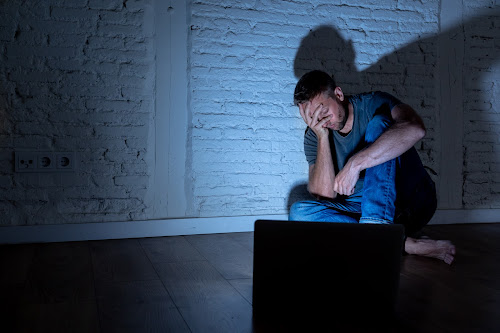
A new client contacted me last week because he just had the first panic attack of his life. He did not have any previous history of anxiety or depression and didn't know what was happening to him. He went to his doctor and she told him to pursue therapy. He lives by himself and works remotely. Covid-19 has him isolated in his house most of the time. His job does not require in-person meetings so he mostly completes his work and submits it electronically. The panic attack occurred a fter he spent the evening watching the news, where he saw people dying in chokeholds and protestors in dangerous confrontations. Before bed, he checked his social media, which was full of footage of violence, threats, fake news, and vile comments from trolls. That evening he had the panic attack complete with feelings of fear and doom, pounding heart, sweating, trembling, shortness of breath and chills. The first thing I told him to was to limit his news and social media browsing and reconnect with ...

Dr Monnica T Williams: Can a White Person Understand the Black Experience?

Image
Today I am posting an article by Monnica T. Williams, Ph.D., ABPP who is a licensed clinical psychologist and associate professor at the University of Ottawa in the School of Psychology, where she is the Canada Research Chair for Mental Health Disparities. Dr. Williams has published over 100 book chapters and peer-reviewed articles focused on anxiety-related disorders and cultural differences. She has served on boards nationwide including the Delaware Valley Association of Black Psychologists, the National Alliance on Mental Illness (NAMI) Main Line chapter, NAMI Louisville, and the OC Foundation of California. Dr. Williams powerfully discusses the ways in which privilege and discomfort keep white people oblivious to racial injustice in America. This is important because I think that this moment in history requires white people to educate themselves about the black experience of racism in order to become better allies. In response to my article, Colorblind Ideology Is a Form of Rac...

CORONAVIRUS DREAMS-A LOCAL SURVEY

Image
CORONAVIRUS DREAMS-A LOCAL SURVEY I have been having vivid, sometimes unsettling, dreams since the pandemic started, and I am not the only one . Psychologists are noticing that many people's dreams have changed since Covid-19. They are not exactly nightmares, but they are definitely pandemic-informed. What are our minds up to? Why such strange dreams now? The current theory about why we dream is that dreams function to process the events in our waking life. An article in New Scientist explains that "the most intense dreaming activity occurs when our brains are working hard to process recent, emotionally powerful experiences." In our current situation with frightening pandemic information bombarding us we all have a lot of emotion to process! In addition, people seem to be sleeping more now that we are working from home and not going out of our houses much. I don't have to get up at 6am to drive my 12-year-old to school, so now I am sleeping until 9 and somet...

5 SKILLS TO DE-ESCALATE FAMILY CONFLICT DURING COVID-19

Image
5 DBT Skills To De-escalate family conflict during COVID-19 We are all stressed during COVID-19 lockdown. In many families, tension and anger are becoming a problem. Couples and siblings are fighting because they are stuck together 24-7 and isolated from their usual routines and support systems. They are also struggling with an unpredictable future. Dialectical Behavioral Therapy is a great counseling modality that helps people manage emotions and decrease conflict in their relationships. Don't worry, I'm not going on and on about DBT theory, but I do want to share one extremely helpful component of DBT: explicit skills instruction. Here are 5 skills from DBT you can learn to help manage irritability and family conflict during shelter-in-place. 1. Interpersonal Effectiveness Skills. The acronym for this set of skills is DEAR MAN (DBT loves acronyms and they actually do help you remember what you are supposed to do). Learn these skills to manage dif...

MANAGING CATASTROPHIC THINKING DURING COVID-19

Image
Today's blog post is an article by fellow therapist, Dr. Jamie Long.  If you are feeling overwhelming panic and fear during the COVID-19 crisis you might be caught up in a cognitive distortion called Catastrophic Thinking.    Read on to see how to identify and manage this destructive thought pattern How to Cope with Catastrophic Thinking During the Coronavirus Pandemic For many of us, concerns and worries have escalated tenfold over the past few weeks. I checked on a friend of mine, a new mom who just temporarily closed her business in response to the novel coronavirus. She’s someone who typically operates right at the edge of functional anxiety. “How’s the anxiety?” I asked her. “Ha! Anxiety?” she joked (sort of). “I’m petrified.” My friend isn’t alone. Folks with or without pre-existing  anxiety  are experiencing a new wave of fears, worries, and downright doom. And the anxiety is valid. Worries and concerns about this pandemic are n...